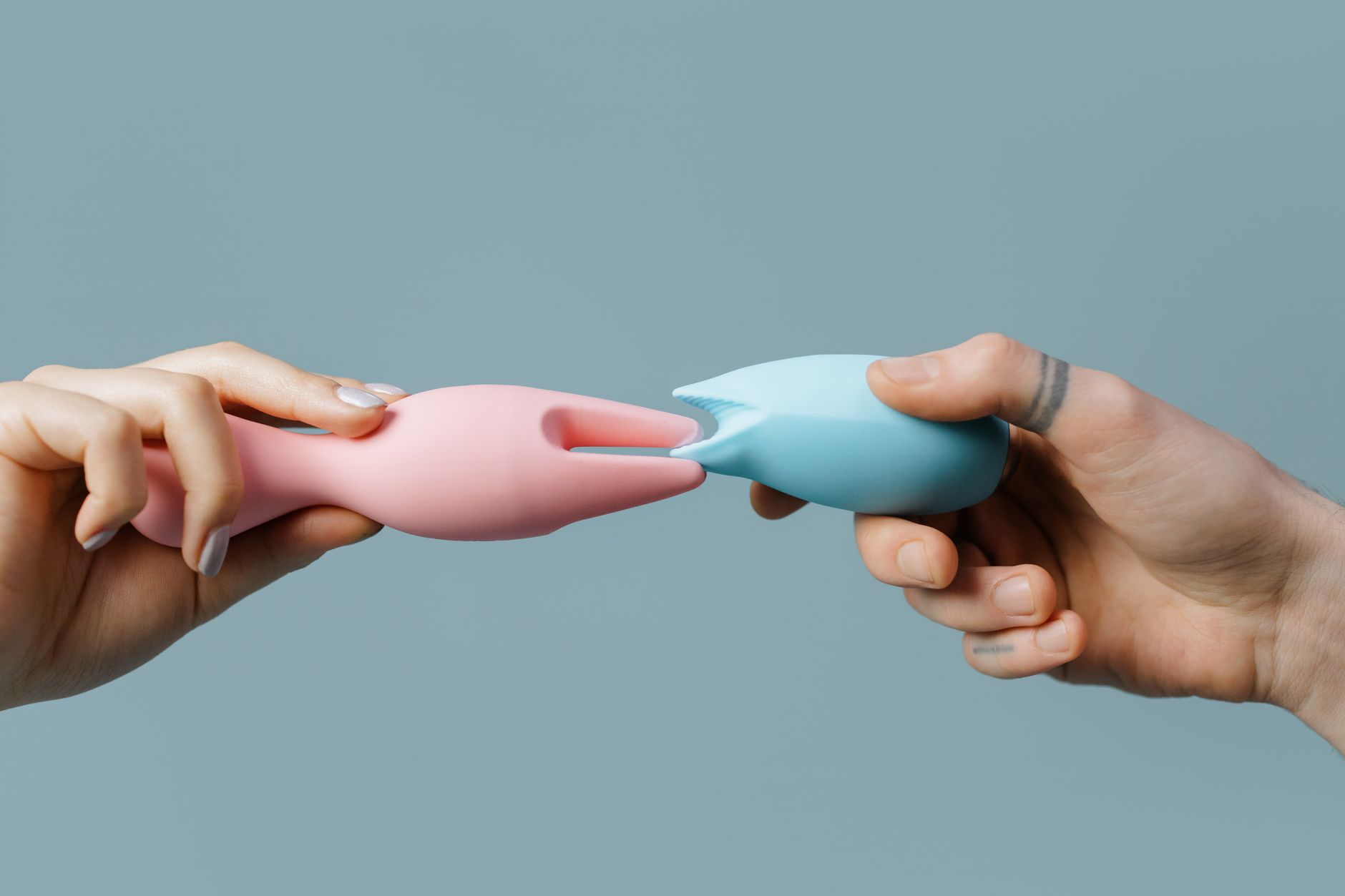
Here's the problem with traditional vibrators for sensitive tissue
You've probably noticed this if your clitoris is easily overwhelmed: a standard bullet vibrator feels like a jackhammer against a nerve ending. It works by grinding mechanical vibration directly onto tissue, which creates a sensation that ranges from pleasurable to "make it stop" in about three seconds. If your clitoris is reactive, tender, or prone to overstimulation, that direct contact feels less like pleasure and more like a neurological emergency.
Lemon clitoral vibrators work on an entirely different principle. Instead of vibration, they use air-pulse technology. Instead of friction, they create a gentle suction sensation that stimulates without touching directly.
The physics of air-pulse versus vibration
Let's break down what's happening at a mechanical level.
A traditional vibrator (bullet, wand, rabbit) relies on a motor that oscillates back and forth at high speed, usually between 3,000 and 10,000 oscillations per minute. That motor is pressed against your skin, transferring every vibration directly into your tissue. For many people, that's perfect. For someone with sensitive clitoral tissue, it's overwhelming.
Lemon suction vibrators work differently. The motor powers an air pump that creates rhythmic pulsing waves. These waves stimulate the tissue around and beneath your clitoris rather than hammering the surface. The sensation is enclosed and gentle. Think of it as a soft, rhythmic hug instead of a persistent tap.
The key difference: vibration stimulates through direct mechanical contact. Air-pulse stimulates through pressure waves. One is like a finger tapping your shoulder. The other is like a breeze you feel rather than something touching you directly.
Why sensitive tissue responds better to pressure than vibration
Your clitoris has roughly 8,000 nerve endings packed into a structure roughly the size of a pea. When that tissue is already reactive, tense, or inflamed, adding high-frequency vibration can feel like overstimulation. Your nervous system gets too much input too fast and shuts down instead of opening up.
Air-suction changes the equation. The stimulation is distributed across a broader area, which means less intense pressure on any single nerve cluster. The pulsing rhythm also gives your nervous system time to process each wave before the next one arrives. This rhythm is closer to how your body naturally responds to arousal, which makes the sensation feel more integrated rather than imposed.
Many people with sensitive tissue also have tension in the pelvic floor. That tension is often a protective response. Your body tightens up when it expects pain or overstimulation. Lemon clitoral vibrators tend to encourage relaxation rather than bracing, which means your nervous system gradually learns that the sensation is safe. Over time, sensitivity often improves.
The role of suction in gentle stimulation
Suction creates something that vibration can't: a sense of containment and build. When you use a lemon vibrator, you're not just receiving stimulation. You're part of a sealed system where sensation accumulates gradually. This matters for sensitive tissue because it allows arousal to develop at your own pace rather than being forced.
The suction also creates a gentle pulling sensation that many people find less intense than direct vibration. The tissue responds differently because the stimulus is different. Instead of rapid oscillation, you're experiencing rhythmic expansion and release. That mirrors the actual physiology of arousal more closely, which is why many people find lemon suction vibrators feel more natural even though they're technically more advanced technology.
Common scenarios where gentleness makes the difference
If your clitoris feels tender after sex or masturbation, a bullet vibrator will make it worse. Lemon clitoral vibrators allow you to continue stimulation at a lower intensity without pain.
If you have a history of yeast infections, vulvodynia, or contact dermatitis, your clitoris may be chronically sensitive. The reduced direct contact from air-pulse technology often means fewer irritation flares.
If you're recovering from clitoral surgery, thinning tissue from hormonal changes, or even just having an off day where your body feels raw, a lemon vibrator gives you gentleness without sacrificing sensation. Many people are shocked at how intensely they can orgasm with air-pulse despite the lower direct pressure.
If you've been using bullet vibrators for years and lost sensitivity, it might feel counterintuitive that switching to something gentler would help. But often, sensitivity rebounds when you stop hammering the tissue. Lemon suction vibrators allow that recovery while still delivering pleasure.
How to introduce air-pulse stimulation if you're used to vibration
Start at the lowest setting. Most lemon vibrators have 5-8 intensity levels. Begin at level 1, which is often barely noticeable. Let your body adjust for a few minutes before increasing.
Use lube, even if you normally don't. Water-based lube makes air-pulse feel even smoother because it improves the seal and reduces any dry friction around the edges.
Don't expect it to feel the same as a bullet. The sensation is fundamentally different. Instead of that sharp tapping, you're experiencing waves. Instead of maximum intensity, you're getting layered stimulation that builds over time. The first time, just explore. Pleasure comes later.
Pay attention to your pelvic floor. If you notice tension, breathe into it and consciously relax. The whole point of gentler stimulation is that your body can stay open instead of bracing.
If lower intensity alone isn't enough pleasure, combine air-pulse with other forms of stimulation. Many people use a lemon vibrator on the clitoris while receiving penetration or using a different toy elsewhere. The gentleness on sensitive tissue doesn't mean less total pleasure, just distributed differently.
Why doctors recommend air-pulse for certain conditions
If you've been diagnosed with genitourinary syndrome of menopause (thinning tissue from low estrogen), or if you have vulvodynia, your healthcare provider may have mentioned air-suction specifically. That's because the research supports it. Air-pulse creates less mechanical stress on fragile tissue while still stimulating nerve endings effectively.
For people managing pain conditions where touch itself can be triggering, air-pulse often feels less invasive. The indirect nature of the stimulation makes it easier for your nervous system to register pleasure instead of threat.
This doesn't mean vibration is bad. It means vibration is intense, and intense isn't always what sensitive tissue needs.
The long-term effect on sensation
Here's something that surprises people: switching to air-pulse often improves sensitivity over time rather than reducing it. That's because you're no longer fatiguing the nerve endings with constant high-intensity stimulation. Your clitoris gets a chance to reset.
Many people report that after a month or two of using lemon clitoral vibrators exclusively, their clitoris feels more responsive to all kinds of touch. Light touch feels more pleasurable. Penetration feels more connected. Solo exploration becomes more nuanced.
This is especially true if you've been chasing orgasm with increasingly intense vibration and found yourself needing more and more to get there. Air-pulse gives your nervous system permission to enjoy subtlety again, which often rekinddles the intensity that vibration alone had lost.
FAQ
Is air-pulse stimulation as strong as vibration?
It's different, not weaker. Many people achieve stronger, more full-body orgasms with air-pulse because the stimulation doesn't fatigue the clitoris. You can also use air-pulse longer without discomfort, which means more time for arousal to build. That often translates to more intense orgasms overall.
Can I use a lemon vibrator if I have latex or silicone allergies?
Most lemon vibrators are made from medical-grade silicone and should be hypoallergenic, but always check the product materials. If you're sensitive to silicone, contact My Lems support for material specifications. Water-based lubrication is compatible with silicone, so you have flexibility there.
Will switching from vibration to air-pulse feel weird at first?
Yes, very likely. Your body is used to a specific type of stimulus, and your nervous system will need time to interpret new sensations as pleasure rather than strangeness. Give yourself at least three sessions before deciding whether you like it. Many people report that disorientation turns into preference once their body adjusts.
How do I clean a lemon suction vibrator to keep the seal working?
After each use, rinse with warm water and mild soap. Make sure you clean the opening that creates the seal, as residue there can weaken suction. Dry completely before storage. If suction decreases over time, the seal may need to be replaced. Check your product manual for replacement parts.
Is air-pulse technology better for everyone?
No. Some people genuinely prefer traditional vibration, and that's completely valid. The difference is that air-pulse is often better for sensitive tissue, recovery, or when you need gentleness without sacrificing sensation. If you love vibration and tolerate it well, there's no medical reason to switch. But if sensitivity has been a barrier, air-pulse is worth trying.
Can I use a lemon clitoral vibrator during pregnancy?
Most healthcare providers clear air-pulse vibrators during pregnancy since there's no direct pressure on the uterus. That said, always check with your OB/GYN, especially if you have a history of preterm labor or placental complications. What feels safe changes depending on your specific pregnancy circumstances.
The bottom line
Lemon clitoral vibrators aren't just a trend. They're a fundamentally different way to stimulate, and that difference matters if your tissue has been tender, reactive, or overwhelmed. Air-pulse technology gives your clitoris the chance to respond to pleasure without defensive tension. For many people with sensitive tissue, that's the only thing that actually works.
If you're curious, your best move is to try it at the lowest setting and give your body permission to adjust. Gentle doesn't mean weak. Sometimes it just means your clitoris finally gets to relax.